Sales training · A free guide

How to sell: the sales method, in eight steps

Most South African businesses struggle to find good salespeople. It isn't that people don't have the potential: they've never been trained to sell. This is the method I built two businesses on, step by step, and how to make it a habit.

By Mike Steenkamp, founder of ShiftMate

25 years in sales · Updated · 25-minute read

Mike Steenkamp, founder of ShiftMate, who wrote this sales training from 25 years in sales

Mike Steenkamp · Founder, ShiftMate

  • 25 yearsin sales, starting with four desks and four telephones
  • Top 10UK foreign exchange brokerage: FC Exchange, sold to private equity
  • 1,000+corporate clients in six years at FX Paymaster, with a small team
ShiftMate Sim Studio

Train your sales team on AI buyers who push back

Practise this method out loud on AI buyers built from your own offer, in ShiftMate Sim Studio. A coach helps during the call and every call is scored on it. Free trial for approved companies, no card needed.

See the method in practice

This is what practising it sounds like

A rep cold calls a busy business owner who starts at no. A coach helps during the call, and the call is scored on the opening and on proving value: the method in this guide. Everyone in it is made up.

Guided demo · a cold call, coached and scored · 63 seconds · narrated · a made-up call

The problem

Most South African businesses struggle to find good salespeople

It isn't that people don't have potential. Most of them have simply never been trained to sell. Nobody has shown them how a buyer decides, given them a method for each part of the call, or made them practise it until it sticks.

Knowing about selling isn't the same as being able to do it when a real buyer says no. That part only comes from practice: saying it out loud, getting feedback, and going again.

Four desks and four telephones: where this sales training comes from

I started my first business at 25, in the UK, with two English friends and my brother. All we had was a big, open 250 m² office with four desks and four telephones. That's where we learned to sell, and we built the business by creating relationships.

That business was FC Exchange. We built it into a top 10 foreign exchange brokerage in the UK, and it was sold to a private equity company.

My second business, FX Paymaster in South Africa, was built the same way. In six years we signed up more than 1,000 corporate clients with a really small team of sales agents. We could do that because we understood the principles of selling: talk to the right people, and demonstrate value. We were also very particular about which customers we wanted to deal with, and about how we serviced and looked after them. FX Paymaster was acquired by another company in the industry in 2025.

  • UK

    FC Exchange

    Built from four desks into a top 10 UK foreign exchange brokerage. Sold to a private equity company.

  • South Africa

    FX Paymaster

    More than 1,000 corporate clients in six years, with a really small sales team. Acquired in 2025.

  • Now

    ShiftMate

    The same principles, built into AI sales training for South African businesses and their sales teams.

Those principles aren't about foreign exchange. They work in any sale to a business, and they can be learned. But you don't learn them by reading. You learn them the way we did: by making call after call until it's how you sell. That's why we built AI sales training.

Why we train with AI

Practise on AI buyers, in a safe place, until it's habit

Practising on real prospects burns real leads, and role play with a colleague only goes so far: they know the script, and they go easy on you. An AI buyer talks, asks questions and pushes back like a real one, as often as you need, and a bad call costs nothing. That's how ShiftMate believes people should learn to sell:

  • 1

    Follow a script

    Your opening, your questions and your answers, said out loud until they come naturally, so you can listen to the buyer instead of your page.

  • 2

    Understand the principles of selling

    Talk to the person who decides, earn the right to their time, show value compared with what they use now, and earn the next step.

  • 3

    Learn the product you're selling

    The AI buyer asks the questions real buyers ask. If you don't know your product, you find out in practice, not on a live call.

  • 4

    Practise different buyers and scenarios

    Friendly, guarded, busy, sceptical. A full call or just the part you find hardest: the opening, an objection, the price, booking a meeting.

  • 5

    In a safe environment

    Practising on real prospects burns real leads. Here a bad call costs nothing: you get feedback, and you go again.

  • 6

    Until it's habit

    Call after call, until it's how you sell without having to think about it. That's how you learn to sell, and how you get results.

Here is the method, step by step.

The method your team practises

The sales method, in eight steps

Talk to the person who decides, and earn the right to their time with a clear opening. Then show, compared with what they use now, that your offer is safer, better, easier, quicker, brings in more business or costs less: the six value principles of selling. Their default answer is no, so you don't aim to close on the first call: you aim to earn the next step.

Then see a practice call scored on these steps.

Steps 1 to 3

Sales training for cold calling: earn the right to talk

A cold call is the hardest place to sell: nobody asked you to call. The script matters, but it starts with the buyer, and the first three steps are about getting a stranger to listen.

Step 1 of 8

Talk to the right person, and know what they care about

Your time is the most valuable thing you have. Before you pick up the phone, check two things. Is this company a fit: is it big enough, and does it have the problem you solve? And is this the person who decides? If you're talking to someone who can't say yes, ask who can, thank them, and move on.

Then think about their role. Each role feels a different pain, so the role decides what you lead with. It doesn't change what your offer is worth. It changes the order you say things in.

  • Admin and office staff

    Lead with EaseSpeed

    Never lead with Price: it isn't their money. Less admin and fewer hassles is what they feel every day.

  • Finance

    Lead with PriceSafetySpeed

    They see the cost, they carry the risk, and they want things done on time.

  • Owner

    Lead with PriceVolume

    It comes out of their pocket, and they want the business to grow.

  • Marketing and sales

    Lead with VolumeQuality

    More leads, and better ones.

  • Operations

    Lead with SpeedEaseQuality

    Work done faster, with less effort, and done right.

  • Procurement

    Lead with PriceQuality

    Their job is the best price for a known standard.

Example: Priya runs the office at a made-up logistics firm. Telling her you're cheaper means little: it isn't her budget. Telling her the monthly supplier statements will take ten minutes instead of her Friday morning means a lot.

Getting past the gatekeeper

Receptionists and assistants protect the decision-maker's time, and they're good at it. Be straight with them: your name, your company and what the call is about, in one sentence. Then ask for help: “Who looks after your supplier accounts?” and the best time to reach them. Never pretend you know the person, or that they're expecting your call.

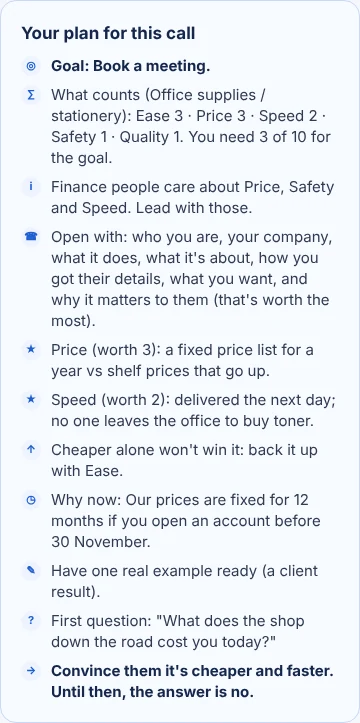
Sim Studio's plan card before a practice sales call: the goal, what counts in office supplies, that finance people care about Price, Safety and Speed, and how to open
The plan before the call. In Sim Studio every practice call starts with this card: the goal, what counts in this industry, what this role cares about, how to open and a reason to act now.

Step 2 of 8

Earn the right to talk: the opening checklist

A cold call is an interruption from a stranger. The buyer doesn't know you, so they start guarded: they don't yet know whether you're wasting their time or bringing them a risk. Until they do, nothing you say about your product counts.

So the opening has one job: answer the questions in their head before they ask them. There are seven, in this order. The last one, why it matters to them, is worth the most.

The opening checklistOut of 10
  1. 1. Who you are

    1
  2. 2. Your company

    1
  3. 3. What your company does

    Must be said, but earns nothing on its own

    0
  4. 4. What the call is about

    2
  5. 5. How you got their details

    1
  6. 6. What you want from this call

    2
  7. 7. Why it matters to them

    Worth the most

    3

Full points

Up front, without being asked

Half

Only when they ask

None

Vague, or never said

An opening that ticks every box
“Hi Johan, it's Karin Botha1from Ridgeway Business Telecoms.2We look after phone lines and internet for small offices.3I'm calling about your move to the new office in Centurion:4I saw it on your company page.5I'd like ten minutes next week to compare what you pay now with what you'd pay with us,6because after a move you may still be paying for lines you no longer use, and that comes straight off your bottom line.7”

Example only: the people and companies are made up.

Until your opening has earned enough points, the call can't move forward: 7 of the 10 for a typical buyer, 8 or 9 for a tough one. The buyer stays guarded and gives short, vague answers: “It's fine.” “We manage.” Many push back once even after a good opening: “I don't really see how this is relevant to me.” Don't answer with another feature. Give a reason tied to them.

Keep it short: how a buyer listens

People on the phone don't say “mm-hm” while you talk. They go quiet, and a quiet buyer isn't necessarily a listening one. A rushed or irritated buyer will cut you off. If your opening takes a minute, you've lost them. Say each part in a sentence, then stop and let them answer.

Credibility comes from facts, not adjectives

“Leading”, “best-in-class” and “innovative” make a guarded buyer more suspicious, not less. Facts build trust: how long you've been trading, how many clients you have, whether you're regulated or accredited. While trust is low, every claim gets checked: “Where does that number come from?” Back it up, or don't say it.

For full calls built on this checklist, see the telesales script examples.

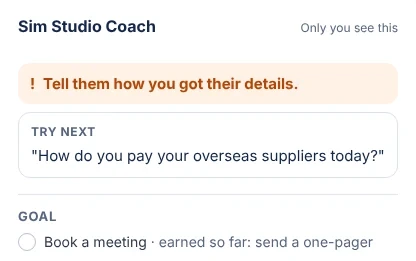
Sim Studio Coach during a practice cold call: a tip to say how you got their details, a suggested next question, and the step earned so far
The coach during the call. Miss a box and Sim Studio Coach tells you which one (“Tell them how you got their details”), suggests your next line, and shows the step you've earned so far. Only you see it; the prospect doesn't.

Step 3 of 8

“Convince me”: the default answer is no

Every buyer on a sales call is thinking the same thing: you need to convince me. Until you show that what you're offering is good for them, the answer is no. That isn't rudeness. It's how busy people protect their time and avoid risk.

“Good for me” has a precise meaning. You have to show at least one of the six value principles (step 4), in their terms, compared with what they use now. A claim on its own isn't enough: “we're faster” gets “Faster than what?”

And the bigger the step you ask for, the more you need to have shown. A buyer who would happily read a one-page comparison will still say no to a meeting if all they've heard is one claim.

How a buyer gets from no to yes
  1. Start

    The answer is no

    Nobody asked you to call.

    What you hear

    • “Who is this?”
  2. Gate 1

    Do I know who you are and why you're calling me?

    Not yet: you hear

    • “Why are you calling me?”
    • “I don't really see how this is relevant to me.”

    Through when

    Opening checklist ticked

  3. Gate 2

    Is it safe?

    Checked first in financial services, insurance, healthcare and software.

    Not yet: you hear

    • “How do I know my money is protected?”

    Through when

    At least as safe as what they have now

  4. Gate 3

    What's in it for me, compared with what I have now?

    Not yet: you hear

    • “Faster than what?”
    • “Sounds too good to be true. What's the catch?”
    • “So what's in this for me?”

    Through when

    Value shown on the value principles that matter to them

  5. Gate 4

    Is it enough for what you're asking?

    A bigger ask needs more value shown.

    Not yet: you hear

    • “Just send me something.”

    Through when

    Next step agreed

  6. Result

    Yes to the next step

    Not the sale: the next step you earned. See step 8.

Steps 4 and 5

The six value principles of selling

Businesses buy for six reasons. These are the six value principles of selling: Safety, Quality, Ease, Speed, Volume and Price. Show at least one of them, clearly, in the buyer's terms, or you haven't shown value. This is the heart of our sales training, and the part most people skip.

Step 4 of 8

Prove value with the six value principles

  • Safety

    1 / 6

    Less risk

    Certainty. Reliable, compliant, protected.

    “Your client money is held in a separate account at a registered bank, never by us.”

    Prove it with: Regulation and licences, how money or data is protected, track record, guarantees, references.

  • Quality

    2 / 6

    A better result

    A better product, service or result.

    “Our fruit is picked the day before it reaches your kitchen. Your current supplier's spends a week in cold storage.”

    Prove it with: Samples, specifications, error or return rates, results for clients like them.

  • Ease

    3 / 6

    Less effort

    Less effort, fewer hassles.

    “You send us one spreadsheet a month. Today your team captures every invoice by hand.”

    Prove it with: A before-and-after walk-through: steps saved, and who does the work.

  • Speed

    4 / 6

    Saves time

    Saves time, quicker results.

    “Payments land the same day, not in three to five working days.”

    Prove it with: Hours saved a week, turnaround times, a live demo.

  • Volume

    5 / 6

    More business

    More leads, sales, customers or capacity.

    “We bring in enquiries on top of the ones your own team finds.”

    Prove it with: Results for similar clients, conversion numbers, capacity added.

  • Price

    6 / 6

    Costs less

    Costs less, or better value for money. Cheaper doesn't mean better.

    “A fixed R250 fee per payment instead of a percentage of every payment.”

    Prove it with: A side-by-side cost comparison, and the saving worked out over a year.

How much each value principle counts, by industry

The value principles don't count equally. Where a mistake is expensive (money, health, data), Safety counts most. Where products are hard to tell apart, Price counts more. In the ShiftMate method each industry gets weights out of 10. The industry tells you what each value principle is worth to buyers in that market; the person's role (step 1) tells you which one to lead with.

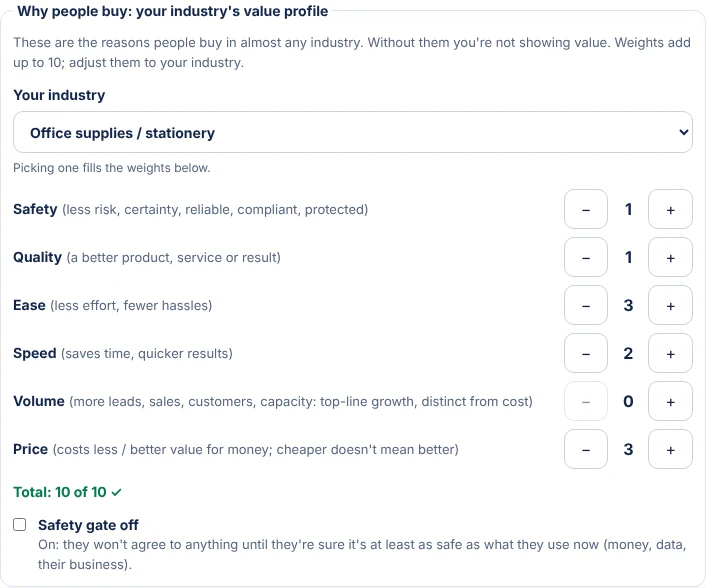
Setting the six value principles of selling in the AI sales training simulator: Safety 1, Quality 1, Ease 3, Speed 2, Volume 0 and Price 3 for office supplies
The weights, in the simulator. Pick your industry and Sim Studio fills in the six value principles (here, office supplies). Adjust them to your market; they must add up to 10.
How much each value principle counts by industry, out of 10, and whether the safety gate is on
IndustrySafetyQualityEaseSpeedVolumePriceGate
Financial services403201On
Insurance412102On
Healthcare431101On
Software213211On
Office supplies113203Off
Fresh produce241102Off
Advertising and marketing121141Off
Recruitment232201Off
Business telecoms223102Off
Solar and energy311104Off
General B2B222211Off
Each row adds up to 10. Gate on: nothing else counts until the buyer is sure it's at least as safe as what they use now (for software, that means their data). These weights are ShiftMate's practitioner judgement, tuned with simulated and real calls: a starting point, not a law. Adjust them to your market.

Compare with what they use now

Value only counts when it's compared with something. Compare with what they do today: their current supplier, their own way of doing it, or doing nothing. That comparison is your value proposition: the reason this buyer should choose you over what they use now, focused on the one or two differences that matter most to them and backed with evidence. To compare, you first have to ask. How do they do it today? What does it cost them? How long does it take? What goes wrong? Then put the difference in their numbers, over a year: four payments a month at R400 less each is R19,200 a year.

One question often does more than a pitch: ask something most buyers can't answer, like “Do you know what margin you're paying on each payment?” It shows the need without criticising anyone. And talk about what you do better, not what the competitor does wrong.

Price is only an issue in the absence of value

What I learned the hard way

“Price is only a problem in the absence of value. Never sell on price as your only value. You'll just end up with a book of clients who squeeze you at every turn and drop you the second a cheaper option comes up.”
Mike Steenkamp
Founder of ShiftMate, 25 years in sales

When a buyer says “it's too expensive”, they usually mean “I don't see enough value for that price yet”. Show value first, in their numbers, and then talk about price. If you really are cheaper for the same thing, frame it in their world: “Two identical products, and one costs more. Would you pay more for exactly the same thing?”

Cheaper doesn't mean better. Often it means the opposite, and buyers know it: when cheaper is the only card you play, they start wondering what you cut to get there. In most industries Price on its own is your weakest card. Lead with what you do better, then show the price.

Don't claim everything: fast, easy, cheap, pick two

Tell a sceptical buyer you're faster, easier and cheaper all at once and they'll ask, “Sounds too good to be true. What's the catch?” Lead with your strongest one or two value principles, the ones that matter most to this person, and prove those.

Step 5 of 8

Safety first in some industries: the safety gate

In some industries the buyer checks safety before anything else. In the ShiftMate method the safety gate is on for financial services, insurance, healthcare and software (where the risk is their data). Their thinking is simple: if it isn't safe, nothing else matters.

Until the buyer is sure your offer is at least as safe as what they use now, no other value counts and they won't agree to a next step. “Trust me” doesn't get you through the gate. Concrete backing does.

Show it's safer than what they use now, not just safe enough, and Safety becomes your strongest card: in these industries it carries the most weight of all six value principles.

The safety gate

On in four industries

Financial servicesInsuranceHealthcareSoftware (data)
“I don't care how fast, easy or cheap it is. If it's not safe, I'm not interested.”

Passes the gate

  • Who regulates you, and your registration or licence
  • Where their money or data is held, and who can touch it
  • How long you've done this, and for how many clients
  • What happens if something goes wrong
  • References they can call
  • “Trust me”

Steps 6 to 8

B2B sales techniques that work

Once they're listening and you've shown value, three sales techniques decide whether you get the next step: a real reason to act now, objections handled without a fight, and an ask that matches what you've earned.

Step 6 of 8

Why now? Give a real reason to act

A buyer can agree with everything you've said and still say, “Sounds fine. Maybe next quarter.” Doing nothing is always the easiest choice. So before you ask for the next step, give them a real reason to act now.

  • What waiting costs them

    In their numbers: “At about R1,600 a month, every month you wait is money you don't get back.”

  • A date that's real

    A contract renewal, a price change, a deadline in their industry.

  • A change in their business

    A move, a new branch, new staff, a busy season coming.

Never invent urgency. A fake deadline destroys trust the moment it's found out. And be consistent: if you've just said every week costs them money, don't suggest meeting in three weeks.

Step 7 of 8

Objections: agree and redirect, and be honest about switching

Never argue with an objection, and never run down the competitor. Agree first, then redirect to what you do better.

Grant, financial director

“We've been with our bank for twenty years. We're happy.”

You

Agree: “That makes sense, and I respect that you've got a long relationship with them. I'm not asking you to change anything today.” Redirect: “Where we usually help is the cost of each payment. Would a side-by-side comparison against what you pay now be useful?”

Example only: the people and companies are made up.

Six objections you'll hear, and what to do

  • We're happy with our current supplier.

    Behind it: Changing feels risky, and nothing is broken.

    Do this: Agree. Say you're not asking them to change anything today, then offer a side-by-side comparison against what they have now.

  • Just send me some information.

    Behind it: A polite way out, or real interest.

    Do this: Agree, ask one question so you send what's relevant, and set a time to go through it together.

  • It's too expensive.

    Behind it: They don't see enough value for the price yet.

    Do this: Go back to value in their numbers, and compare the total over a year with what they pay now.

  • We're too small for this.

    Behind it: They don't think it's meant for them.

    Do this: Show what it means at their size, with a number.

  • We tried something like this before.

    Behind it: A bad experience: risk.

    Do this: Ask what went wrong, then show what's different, with proof.

  • I don't have time.

    Behind it: You haven't shown why it matters to them yet.

    Do this: One sentence on why it matters to them, then ask for a better time.

More objections, each with an example answer: objection handling examples.

Be honest about switching

In most sales the buyer has to switch, and switching isn't free. It takes effort, it can cost money, and it feels risky. Pretending otherwise is the fastest way to lose their trust. Say plainly what's involved: what changes for them, who does the work, how long it takes, what it costs, and any trial or exit terms. Make it smaller only with what's true.

Then show why it's worth it: safer, better, easier, faster or cheaper, in their numbers. If your offer isn't clearly better on at least one value principle that matters to them, they won't switch, and they're right not to. If you don't know an answer, say so and offer a follow-up with someone who does. Never bluff.

Step 8 of 8

You don't close on the first call: earn the next step

Someone who has never heard of you won't buy from you on the first call. On that call you give information, gather information, establish credibility and show value. Only then can you ask for something, and what you ask for should match what you've earned.

The ask ladderEach step needs more value shown
  1. Send information

  2. A short follow-up call

  3. A meeting or demo

  4. A trial

  5. The decision

A first call to a stranger usually earns the first rung or two. Ask for more than you've earned and the answer goes back to no.

A good first call ends like this: they know who you are and what you do, there's interest and a need, you have what you need to follow up, and you've agreed to send information with a set time to talk again.

Two kinds of call

First-contact call

1 to 2 minutes · Goal: send information and agree a follow-up

  1. 1Your name and company
  2. 2One line on why you're calling them
  3. 3ONE difference, with a number
  4. 4The ask: “Can I send you a short comparison and call you on Thursday to go through it?”
  5. 5Get the email address and the time
  6. 6Not for them? Don't take it personally. Move on.

Value call

10 to 15 minutes · Goal: the next step, after a comparison

  1. 1Refer back to the first call
  2. 2Say why you're calling: to understand how they do it today and show where you could add value
  3. 3Deal with the obvious up front: “You may be happy where you are. I'm not asking you to change anything today.”
  4. 4A conversation, not a speech: how they do it now, the value principles that matter to them, a side-by-side comparison, the saving over a year
  5. 5End with a recap email listing what's needed to start, and a set follow-up

South Africa

Selling to South African businesses

  • Make the safety answer concrete. In financial services and insurance that means who regulates you and your licence or registration number (for example, your FSP number), not “trust me”.
  • Say honestly how you got their details. It's part of a good opening, and the Protection of Personal Information Act (POPIA) sets rules on how businesses use people's personal information, including for direct marketing. Check what applies to you.
  • Put value in rand, over a year. “Four payments a month at R400 less each is R19,200 a year” lands; “we're cheaper” doesn't.

Read the feedback

Sales training in practice: one call, scored on the method

Here is the method at work on one practice call in Sim Studio for Sales Teams. Megan, a rep at an FX company, calls Grant, a financial director who has never heard of her, to book a meeting. Below is the call, the report written straight afterwards, and the coach's feedback on it, one report section at a time. In the app the coach also reads this feedback to you, at the top of every report.

Made up for this page: the people, the companies, the call and the scores are fictional.

Coach's feedback

8 points

Practice callFinancial servicesRealisticGoal: book a meeting01:25

Rep

Megan Fraser

Amberleaf FX

AI prospect

Grant Peters

Financial director, Highveld Fittings

The call

  1. 00:03 · Megan

    Hi Grant, it's Megan Fraser from Amberleaf FX. We handle overseas payments for importers. I'm calling about your supplier payments to Germany: I'd like ten minutes next week to compare what you pay now with what you'd pay with us, because the margin on each payment is a cost most importers never see.

  2. 00:19 · Grant

    We've used our bank for twenty years. Everyone tells me they're cheaper.

  3. 00:24 · Megan

    That makes sense, and I'm not asking you to change anything today. We charge a fixed R250 a payment instead of a percentage. On a R500,000 payment, a 1% margin is R5,000.

  4. 00:39 · Grant

    And how do I know my money's safe with you? I've never heard of you.

  5. 00:44 · Megan

    Fair question. We're an authorised financial services provider, and your money sits in a separate client account at a registered bank, never with us. I'll send you our licence number and two clients you can call.

  6. 00:58 · Grant

    Cheaper on its own isn't worth the hassle of changing.

  7. 01:02 · Megan

    Agreed, price alone isn't a reason to switch. Payments land the same day instead of in two to three days, you keep your bank account, and it's much easier to use. Your next payment to Germany is due this month, so you'd see the difference straight away. Could we take twenty minutes on Thursday at ten?

  8. 01:21 · Grant

    Thursday at ten works. Send me the invite.

  1. The result

    Coach: “Good call: seventy-eight out of a hundred. You booked a twenty-minute meeting with a financial director who'd never heard of you. On a first call, that's the win.”

    Call report · Financial services · Realistic

    Meeting booked: Thursday, 20 minutes

    Next step earned. Two things to fix.

    Opening
    9/10
    7 needed
    Value
    7/10
    3 needed
    You talked
    64%
    they: 36%
    Safety gate passedReason to act now givenTrust: Low → Earned
  2. Your opening

    Coach: “Your opening scored nine out of ten. You said who you are, what you wanted and why it mattered to him, without being asked. The one gap: you never said how you got his details.”

    Opening checklist9/10 (7 needed to open up)

    • Who you are1/1
    • Your company1/1
    • What your company does0/0
    • What the call is about2/2
    • How you got their details0/1
    • What you want from this call2/2
    • Why it matters to them3/3
  3. The safety gate

    Coach: “When he asked if his money was safe, you didn't say trust me. You gave him facts: who regulates you, and where his money sits.”

    Passed at 00:44 · gate on for financial services

    “We're an authorised financial services provider”

  4. Their trust in you

    Coach: “That's where his trust turned.”

    1. low · 00:00

      A stranger calling: he starts guarded

    2. building · 00:24

      You agreed instead of arguing, and put a number on the price

    3. earned · 00:44

      Safety answered with facts, not “trust me”

    Claim never backed: “It's much easier to use” (he let it go, but it didn't count)

  5. What was in it for them

    Coach: “Your value score was seven out of ten. Safety, speed and price were proven against what he uses now. But you said it's much easier to use, and never showed how. Here, ease is worth three points.”

    Value score7/10 (3 needed for a meeting)

    Weighted for financial services: Safety 4 · Ease 3 · Speed 2 · Price 1. Quality and Volume count 0 here.

    • Safety4/4 · proven at 00:44

      “your money sits in a separate client account at a registered bank, never with us”

    • Ease0/3 · claimed, not proven against what they use now

      “it's much easier to use”

    • Speed2/2 · proven at 01:02

      “the same day instead of in two to three days”

    • Price1/1 · proven at 00:24

      “a fixed R250 a payment instead of a percentage”

  6. A reason to act now

    Coach: “You gave him a real reason to act now: his next payment is due this month.”

    Given at 01:02

    “Your next payment to Germany is due this month”

  7. Your best line

    Coach: “Your best line: I'm not asking you to change anything today. You agreed first, so he kept listening.”

    “That makes sense, and I'm not asking you to change anything today.”
    00:24 · You agreed before you redirected, so he kept listening.
  8. What to fix next time

    Coach: “Next time: say how you got their details, and ask how they pay suppliers today, so you can prove it's easier.”

    1. 1Say how you got their details in the opening. One sentence: “I saw on your website that you import from Germany.”
    2. 2Prove Ease: ask how his team pays suppliers today, then compare. In financial services Ease is worth 3, as much as Speed and Price together.

Get this report on your own calls. Every practice call ends with your opening score, your value score and what to say next time.

For businesses

From your sales material to a training simulation

The method is the same in every business; the product, the buyers and the objections aren't. So we turn your own sales material into a practice campaign your team can call the same day it's approved. Set it up yourself in Sim Studio, or we build it for you, for R3,500 (excl. VAT) once per campaign.

  1. 1You send us your product material.
  2. 2We research your market, your competitors and your buyers.
  3. 3We build the campaign: the offer, the buyer types, realistic prospects, the script, the objections and the scorecard.
  4. 4We test it with 50 simulated practice calls.
  5. 5One of our team makes live practice calls on it.
  6. 6You approve it, and your team practises the same day.
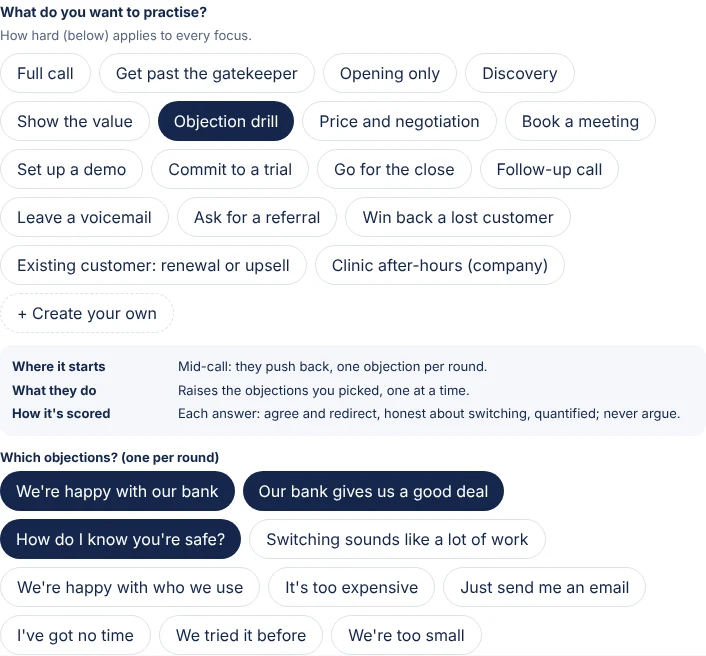
Choosing what to practise in the AI sales training: full call, gatekeeper, opening only, objection drill, price and negotiation and more
Then your team practises one part at a time. A full call, the gatekeeper, the opening, an objection drill, price, booking a meeting, and how tough the buyer is: Friendly, Realistic, Tough or Brutal.

Experience, checked against evidence

The research behind it

The method comes from practice, not from a textbook. But you shouldn't have to take my word for it, so here is the published research it lines up with.

  1. 1. Eric Almquist, Jamie Cleghorn and Lori Sherer (Bain & Company), “The B2B Elements of Value”, Harvard Business Review, March–April 2018.

    What it found: Business buyers weigh up to 40 “elements of value”, from table stakes such as meeting specifications, an acceptable price and regulatory compliance, through functional and ease-of-doing-business value, to personal concerns such as reduced anxiety and reputational assurance.

    How the method uses it: The six value principles are a short version you can use on a phone call: cost reduction sits under Price, time savings under Speed, reduced effort and fewer hassles under Ease, product quality under Quality, a bigger top line under Volume, and risk reduction and compliance under Safety. Buying the wrong thing is a personal risk for the buyer, which is part of why Safety weighs so much.

  2. 2. James C. Anderson, James A. Narus and Wouter van Rossum, “Customer Value Propositions in Business Markets”, Harvard Business Review, March 2006.

    What it found: Value propositions that list every benefit, or every difference from a competitor, are weaker than a “resonating focus”: the one or two differences that matter most to the customer, shown against the customer's next best alternative and backed with evidence.

    How the method uses it: Compare with what they use now, back it with a number, and lead with your strongest one or two value principles instead of claiming everything.

  3. 3. Daniel Kahneman and Amos Tversky, “Prospect Theory: An Analysis of Decision under Risk”, Econometrica, 1979.

    What it found: People weigh a loss more heavily than a gain of the same size: losses loom larger than gains.

    How the method uses it: A change of supplier feels like a possible loss, so buyers start guarded and Safety counts heavily. What waiting costs them is a stronger reason to act now than what they might gain, as long as it's true.

  4. 4. William Samuelson and Richard Zeckhauser, “Status Quo Bias in Decision Making”, Journal of Risk and Uncertainty, 1988.

    What it found: People stick with their current option far more often than a plain comparison of the options would predict.

    How the method uses it: The default answer is no. Value has to be shown against what they use now, and switching has to be dealt with honestly, not wished away.

  5. 5. Neil Rackham, SPIN Selling (McGraw-Hill, 1988), based on research covering about 35,000 sales calls.

    What it found: In larger sales, the more successful salespeople asked more questions about the buyer's problems and what those problems cost them, and successful calls ended with the buyer agreeing to a specific step forward (an “advance”) rather than a vague promise to keep talking. Classic closing techniques that can work in small sales tended to hurt in larger ones.

    How the method uses it: Ask before you tell, and aim each call at an earned next step instead of pushing for the close.

What's ours, not the researchers': the six value principles as a set, the industry weights and the opening checklist's points are ShiftMate's practitioner judgement, built from 25 years of selling and tuned with simulated and real calls. They fit the research above, but they aren't the result of a controlled study. Treat them as a starting point and adjust them to your market.

Mike Steenkamp, ShiftMate founder and author of this sales training guide

About the author

Why listen to me?

Mike Steenkamp · Founder, ShiftMate · 25 years in sales

I started my first business, FC Exchange, at 25 in the UK, with two friends and my brother, four desks and four telephones. We built it into a top 10 foreign exchange brokerage in the UK, and it was sold to a private equity company. My second business, FX Paymaster in South Africa, signed up more than 1,000 corporate clients in six years with a really small team of sales agents, and was acquired by another company in the industry in 2025.

The principles on this page are the ones we built both businesses on. Through ShiftMate I'm building them into AI sales training, to help other people build their businesses and their sales teams.

So you know: ShiftMate sells the AI sales training on this page.

Sales training FAQs

What is sales training?

Sales training teaches people how to sell: how to reach the person who decides, open a conversation with a stranger, show value the buyer can check, handle objections and agree a next step. Good sales training gives you a method you can explain in a sentence, then makes you practise it out loud, with feedback, until it sticks.

What is AI sales training?

AI sales training lets salespeople practise sales calls with AI buyers who talk, ask questions and push back like real ones, and get feedback after every call. Your team follows the script, learns the principles of selling and the product, and practises different types of buyers and scenarios in a safe place, until selling is a habit, before a real lead is on the line.

How much does AI sales training cost?

ShiftMate's AI sales training is month to month, in rand. Just me is R799 a month for one person with 2 practice hours. Team plans are priced at R350 an included practice hour, shared by the whole team: Micro R3,500 (2 to 3 reps, 10 hours), Small R7,000 (up to 5 reps, 20 hours), Medium R21,000 (up to 15 reps, 60 hours) and Large R56,000 (up to 40 reps, 160 hours). Enterprise and call centres with more than 40 reps are priced on request. A once-off pilot is R3,500 for up to 5 reps and 10 hours over 30 days.

What is the best sales training in South Africa?

There's no single best course for everyone, so judge any sales training in South Africa on three things. Is it built on a method you can explain in a sentence? Do you practise out loud and get feedback on every attempt, not just listen? And does it fit how you sell: to businesses, on the phone, in your industry? The method on this page is free to read, and your team can practise it with ShiftMate's AI sales training, built in South Africa for South African buyers.

How long does sales training take?

You can read the method on this page in about half an hour. Making the method stick takes longer, because selling is a skill: it comes from using the method out loud, again and again, and fixing one thing at a time. Short practice calls with feedback, spread over weeks, work better than one long workshop you never repeat.

Can anyone learn to sell?

Yes. With the right approach anyone can learn to sell. Selling has a recipe: talk to the person who decides, earn the right to their time with a clear opening, show value on the six value principles compared with what they use now, and earn the next step. Mike Steenkamp, ShiftMate's founder, learned it in an office with four desks and four telephones, and used it to build two businesses.

How do you practise sales calls?

Practise out loud against a realistic buyer before you call real prospects, and get feedback on every call. Role-play with a colleague works if they push back like a real buyer. An AI sales training simulator lets you practise any time: ShiftMate's AI sales training gives you an AI prospect who starts at no, a coach during the call, and a report afterwards with your opening and value scores.

What are the six value principles of selling?

The six reasons businesses buy: Safety (less risk: certainty, reliable, compliant, protected), Quality (a better product, service or result), Ease (less effort, fewer hassles), Speed (saves time, quicker results), Volume (more leads, sales, customers or capacity) and Price (costs less, or better value for money; cheaper doesn't mean better). How much each one counts depends on the industry, and who you're talking to decides which you lead with.

What is B2B sales training?

B2B sales training teaches you to sell to businesses rather than to consumers. The buyer is spending the company's money and carries the risk if it goes wrong, so it focuses on reaching the person who decides, showing value against what the business uses now, in its own numbers, dealing honestly with what switching involves, and earning one next step at a time instead of pushing for a sale on the first call.

How do you handle “we're happy with our current supplier”?

Agree and redirect. Agree that it makes sense and say you're not asking them to change anything today. Then redirect to the one thing you do better and offer a side-by-side comparison against what they pay or get now. Never argue, and never run down their current supplier.

How do you get past a gatekeeper?

Be straight with them. Give your name, your company and what the call is about in one sentence, then ask for help: “Who looks after your supplier accounts?” Ask for the best time to reach that person. Never pretend you know the decision-maker or that they're expecting your call.

Is AI sales training effective?

It's a good way to get practice and feedback, but it isn't magic. An AI sales training simulator lets you make many practice calls without burning real leads and tells you straight away what you missed. It doesn't replace real calls or a good manager, and how well it works depends on the method it scores you on. ShiftMate's scoring follows the method on this page, and we keep tuning it with simulated and real calls.

Last updated 10 November 2026.

Turn potential into salespeople

Your team practises this method with realistic South African buyers until selling is a habit. One extra sale can pay for the whole month.