Sales call scorecard: a template with weights you can copy
A sales call scorecard is a short list of the things a good call must contain, each with a weight, so every call is marked the same way. The template below has eight lines that add up to 100, three marks (done, partly, missed) and four automatic fails. A step the call didn't need is marked not applicable and left out. Mark only what you can quote from the call, then coach one line at a time.

Have every practice call scored for you
Your team practises on AI buyers built from your own offer, in ShiftMate Sim Studio. Every call is scored and reported when it ends. Free trial for approved companies, no card needed.

What is a sales call scorecard?
A sales call scorecard is a short list of the things a good call must contain, each with a weight. After the call, someone marks each line. The rep gets a score and, more useful than the score, the one line to fix first. The template here is built on the six value principles of selling, from the opening to the next step.
Without one, feedback depends on who listened. One manager says “good energy”, another says “too pushy”, and the rep learns nothing they can repeat. With one, every call is marked the same way, by anyone.
That method was written by ShiftMate's founder Mike Steenkamp. The eight lines follow it in the order things happen on a call. One line, asking what the buyer uses now, is not a step of its own in the method: it is what proving value depends on, so it gets its own line here.
- Eight lines, with weights that add up to 100. Proving value carries the most.
- Three marks: done, partly, missed. A step the call didn't need is “not applicable”. Mark only what you can quote from the call.
- Four automatic fails that no score can make up for.
- Set your own pass mark from your own calls. Don't borrow someone else's.
- Coach one line at a time, then run the call again.
The sales call scorecard template
Eight lines, in call order. “What done sounds like” is what the marker listens for. Each line links to the step of the method it comes from.
| Line | What done sounds like | Points |
|---|---|---|
| 1. Spoke to the right person | Checked early that this person decides, or found out who does, before pitching. | 5 |
| 2. Earned the right to talk | The opening said who they are, their company, what it does, what the call is about, how they got the details, what they want from the call and why it matters to the buyer. | 15 |
| 3. Asked what the buyer uses now | Asked at least one question about what the buyer does today, and let them answer, before describing the offer. | 15 |
| 4. Proved value | Showed one of the six value principles (Safety, Quality, Ease, Speed, Volume, Price), compared with what the buyer uses now, with a number or an example. | 25 |
| 5. Showed it's safe | Said plainly why it is at least as safe as what the buyer has now: who regulates it, where the money or data sits, who else uses it. | 10 |
| 6. Gave a real reason to act now | Named what waiting costs, a real date, or a change in the buyer's business. Never invented urgency. | 5 |
| 7. Agreed and redirected | Agreed with the objection first, then redirected to what they do better, and was honest about what switching involves. | 15 |
| 8. Earned the next step | Agreed a next step with a day and a time, and said what happens before then. | 10 |
| Total | 100 |
Copy the template
Paste this into a document, or download it as a spreadsheet (opens in Excel or Google Sheets).
SALES CALL SCORECARD
Rep:                Call date:            Marked by:
Call type:          Goal of the call:

Mark each line: Done (full points) / Partly (half) / Missed (0) / Not applicable (left out)
Write the words from the call that the mark is based on.

1. Spoke to the right person (5)  Mark: ____  Their words: ____
2. Earned the right to talk (15)  Mark: ____  Their words: ____
3. Asked what the buyer uses now (15)  Mark: ____  Their words: ____
4. Proved value (25)  Mark: ____  Their words: ____
5. Showed it's safe (10)  Mark: ____  Their words: ____
6. Gave a real reason to act now (5)  Mark: ____  Their words: ____
7. Agreed and redirected (15)  Mark: ____  Their words: ____
8. Earned the next step (10)  Mark: ____  Their words: ____

Score: points earned / points that applied x 100 = ____   (all eight lines = 100)

AUTOMATIC FAILS (any one fails the call, whatever the score)
[ ] Said something untrue about the product, the price or the terms
[ ] Invented urgency or made up a figure
[ ] Carried on selling after the buyer asked to be taken off the list
[ ] Left out a line the company must say on every call

One thing done well: ____
One thing to fix first: ____
Say this instead: ____
How to mark a call
Three marks are enough. A scale of one to five sounds more exact, but the difference between a three and a four is hard to write down, so two markers drift apart. Done, partly and missed are easier to agree on. A fourth option, not applicable, is for a step the call didn't need.
| Mark | When to give it | Points |
|---|---|---|
| Done | The rep did it clearly, and you can quote the words. | All of the line's points |
| Partly | The rep tried, but something was missing: value with no number, a next step with no day or time. | Half |
| Missed | It didn't happen, or you can't find the words for it. | None |
| Not applicable | The line doesn't fit this call. A gatekeeper call has no value step; office supplies has no safety gate. | Left out of the total |
- 1
Quote the call
Next to every mark, write the rep's words that earned it. If you can't quote it, it didn't happen. This one habit ends most arguments about a score.
- 2
Work out the score
Add the points earned and divide by the points that applied. If a line was not applicable, leave it out of both numbers, so the rep isn't punished for a step the call didn't need.
- 3
Check the automatic fails
Go through the four below. Any one of them fails the call, whatever the score.
- 4
Write one fix
Pick the missed or partly-done line worth the most points. If two are level, pick the one that came closest to ending the call. Write what the rep said and what to say instead. That is the coaching.
Automatic fails
Some things can't be made up for by a strong opening. Keep this list short, so that it means something. These four apply to any sales call; add the lines your own company or industry must say.
| Automatic fail | Why no score makes up for it |
|---|---|
| Said something untrue about the product, the price or the terms | The sale is built on it. The customer finds out later, and you lose them and their word of mouth. |
| Invented urgency or made up a figure | A deadline or a saving that isn't real is still something untrue, however well the rest of the call went. |
| Carried on selling after the buyer asked to be taken off the list | The call is over the moment they ask. Confirm the removal and end politely. |
| Left out a line the company must say on every call | For example a recording notice, or who you are and who you represent. Check the exact wording, word for word. |
One call, scored
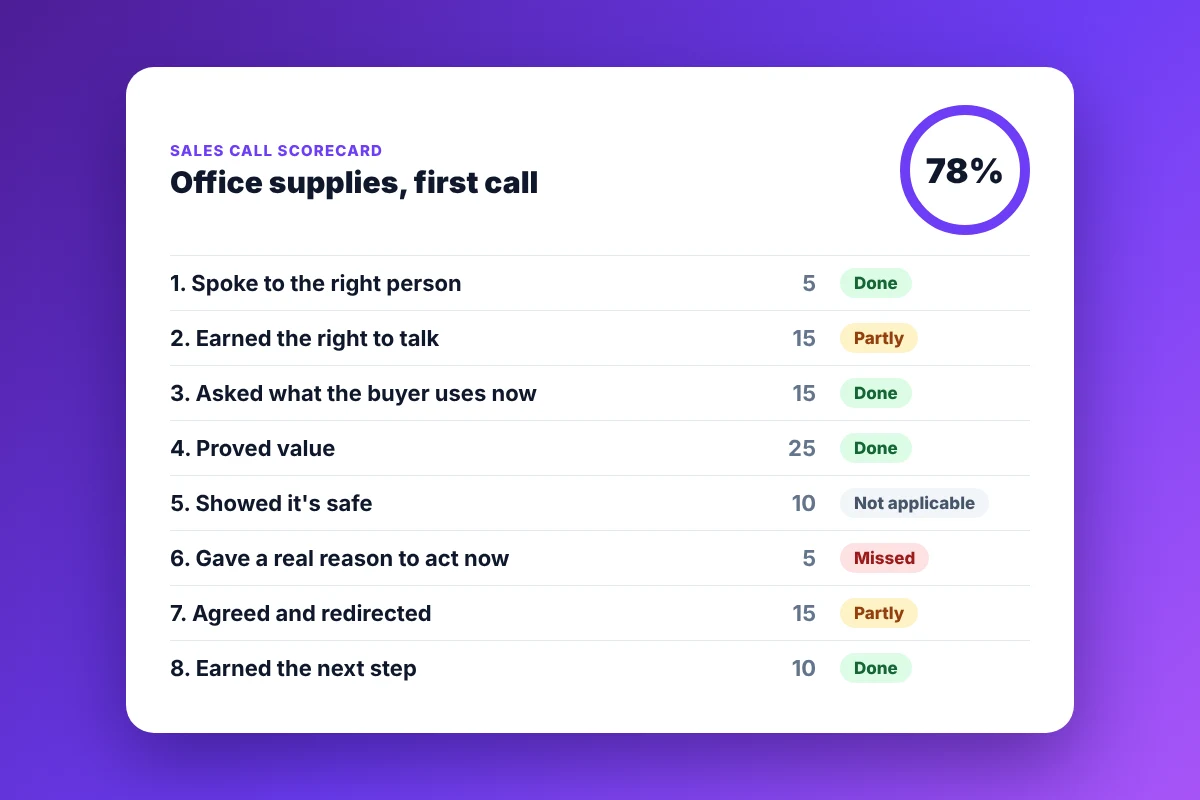
A made-up first call, then the scorecard for it. The seller supplies offices with stationery and cleaning products. Office supplies has no safety gate in the method, so that line is not applicable here.
Hi, is that Karin Botha? It's Ravi from Deskmate. We supply offices with stationery and cleaning products. You look after the ordering for the office, is that right?
I do. What's this about?
I'm calling about how long your orders take to arrive. Most offices we speak to plan a week ahead because of delivery times, and I'd like to see if we can take that off your plate.
A clear reason for the call and why it matters to the buyer. Nothing on how the seller got the details or what the seller wants from this call.
Okay.
Can I ask who you order from at the moment, and how long an order takes?
A question before any pitch.
One of the big national suppliers. Four or five days. We just order early.
So you plan a week ahead. We deliver the next working day, at the same prices on your top twenty items. You could order on a Monday for Tuesday.
Speed, compared with what the buyer has now, with a number.
We're happy with them, though.
We'd have it with you the next day instead of in five.
A redirect, with no agreement first and nothing about what switching involves.
I'd have to see the prices side by side.
Of course. If you send me your last invoice, I'll put our prices next to it, line by line. Can I call you on Wednesday at two to go through it?
Fine. Wednesday at two.
| Line | Mark | The words it's based on | Points |
|---|---|---|---|
| 1. Spoke to the right person | Done | “You look after the ordering for the office, is that right?” | 5 of 5 |
| 2. Earned the right to talk | Partly | “I'm calling about how long your orders take to arrive.” Clear, but not how the seller got the details or what the seller wants from the call. | 7.5 of 15 |
| 3. Asked what the buyer uses now | Done | “Can I ask who you order from at the moment, and how long an order takes?” | 15 of 15 |
| 4. Proved value | Done | “We deliver the next working day, at the same prices on your top twenty items.” | 25 of 25 |
| 5. Showed it's safe | Not applicable | Office supplies has no safety gate. | n/a |
| 6. Gave a real reason to act now | Missed | Nothing said about why this week and not next quarter. | 0 of 5 |
| 7. Agreed and redirected | Partly | “We'd have it with you the next day instead of in five.” A redirect with no agreement first. | 7.5 of 15 |
| 8. Earned the next step | Done | “Can I call you on Wednesday at two to go through it?” | 10 of 10 |
| Score | 70 of the 90 points that applied | 78% |
The seller asked what the buyer uses now before describing the offer, so the value shown was about the buyer's week, not the seller's catalogue.
The opening and agree and redirect each earned half of 15. The objection is the one that nearly ended the call, so it comes first: “we're happy with them” was answered with the delivery time straight away. Agree first.
“That makes sense. If they're reliable, I wouldn't change either. The one difference is ordering on Monday for Tuesday, and switching is a single form. Would a side-by-side with your last invoice be useful?”
Change the weights for your business
The weights above are a starting point for a business-to-business sales call. Three changes make the scorecard yours.
- 1
Move points to what your buyers need to hear
Where a mistake is expensive for the buyer (money, health, data), nothing else counts until they are sure it's safe. In the method, financial services, insurance, healthcare and software have a safety gate. If you sell in one of them, raise “Show it's safe” to 20, and take five points from the opening and five from asking what the buyer uses now.
- 2
Add the lines your company must say
A recording notice, who you are and who you represent, a product disclosure. Put each one under automatic fails, word for word, so the marker checks the exact wording.
- 3
Set the pass mark from your own calls
Mark ten calls from your strongest salespeople and ten ordinary ones. Put the pass mark where the strong calls sit above it and most ordinary calls sit below. Check it again after a month.
Use a different scorecard for a different kind of call. A first cold call is mostly opening and next step; a follow-up call is mostly value and objections. One scorecard stretched over both marks neither well.
Coach from the scorecard
- 1
Have the rep mark the call first
They listen to their own call and fill in the scorecard before you show them yours. Where the two differ is where the conversation should start.
- 2
Pick one line
The missed or partly-done line worth the most points; if two are level, the one that came closest to ending the call. Not three lines. A rep who is told to fix everything fixes nothing.
- 3
Give the words
Read out what they said, then what to say instead. “Be more consultative” is not something anyone can do on the next call.
- 4
Run the call again
Same buyer, same goal, one change. With a colleague playing the buyer, or on an AI buyer. Then mark it again and compare the one line.
- 5
Look across the team once a month
If most of the team misses the same line, the problem is the training, not the people. Fix it once, for everyone.
Check that two people mark the same way
Before you rely on the scores, have two people mark the same five calls separately and compare line by line. Where they disagree, the “what done sounds like” wording is too vague; tighten it until they agree. Do it again whenever you change the scorecard.
Mistakes to avoid
- Too many lines. Past ten, markers rush and reps stop reading.
- Marking how the rep sounded. “Confident” and “friendly” are opinions. Mark what was said.
- Marking accent. It tells you nothing about whether the buyer was given a reason to say yes.
- A score with no fix. A number on its own changes nothing on the next call.
- Punishing a step the call didn't need. Use “not applicable” and leave it out of the total.
- Letting a high score hide an automatic fail. A call with something untrue in it is a failed call.
- Changing the scorecard every few weeks. Nobody can see themselves improve against a moving target.
How ShiftMate and ShiftMate Sim Studio help
ShiftMate Sim Studio is where a sales team practises calls on AI buyers built from the company's own offer. Every practice call gets a report when it ends, and each mark quotes the words from the call it is based on. A company can set up its own scorecard, with its own weights and automatic fails, and have calls marked on that, on the ShiftMate method, or on its own scorecard with the ShiftMate method shown alongside. The report shows one thing to fix first, and the rep can run the call again straight away.
ShiftMate is the South African marketplace where contact centres and businesses hire call centre agents who have already been assessed, so the people you coach arrive with the basics in place.
To try scoring on a practice call, start with the sales call simulator and pick the “Opening only” practice: it scores just your opening, the second line of this scorecard.
Questions people ask
What is a sales call scorecard?
A sales call scorecard is a short list of the things a good sales call must contain, each with a weight. A manager, a colleague or an AI marks each line after the call, so every call is judged the same way and the rep knows exactly what to fix.
What should a sales call scorecard include?
The steps of your sales method, in call order: speaking to the right person, the opening, asking what the buyer uses now, proving value, showing it's safe, a real reason to act now, handling objections and agreeing a next step. Add a short list of automatic fails, such as saying something untrue.
How many lines should a sales call scorecard have?
We suggest six to ten. With fewer, the score hides what went wrong. With more, nobody finishes marking the call, and the rep can't tell which line matters. The template here has eight.
How do you weight a sales call scorecard?
Give the most points to the lines that decide whether the buyer says yes. In this template, proving value carries 25 of 100. Then shift points to match your business: where a mistake is expensive for the buyer, showing it's safe should count for more.
What is a good score on a sales call scorecard?
It depends on your scorecard, so set the pass mark from your own calls. Mark ten calls from your strongest salespeople and ten ordinary ones. Put the pass mark where the strong calls sit above it and most ordinary calls sit below.
What is an automatic fail on a call scorecard?
An automatic fail is something that fails the whole call whatever the score: saying something untrue about the product or the price, inventing urgency or figures, carrying on selling after the buyer asked to be taken off your list, or leaving out a line your company must say on every call.
How often should you score sales calls?
Often enough that the rep still remembers the call: the same day is best. A manager with little time can score two calls a week for each rep and coach one line from them. An AI practice call is scored as soon as it ends.
Can AI score a sales call?
Yes. In ShiftMate Sim Studio every practice call gets a report when it ends, and each mark quotes the words from the call it is based on. Calls can be marked on the ShiftMate method or on a scorecard your company sets up.
Have your practice calls scored for you
Practise on an AI buyer who starts at no. You get a report after every call, with the words each mark is based on and one thing to fix first.
Keep going
The six value principles of selling, step by step.
Agree and redirect, with answers to the eight objections you hear most.
Eight scenarios with secret buyer briefs and scripts.
Four full scripts and how to write your own.