TL;DR — Quick Answer
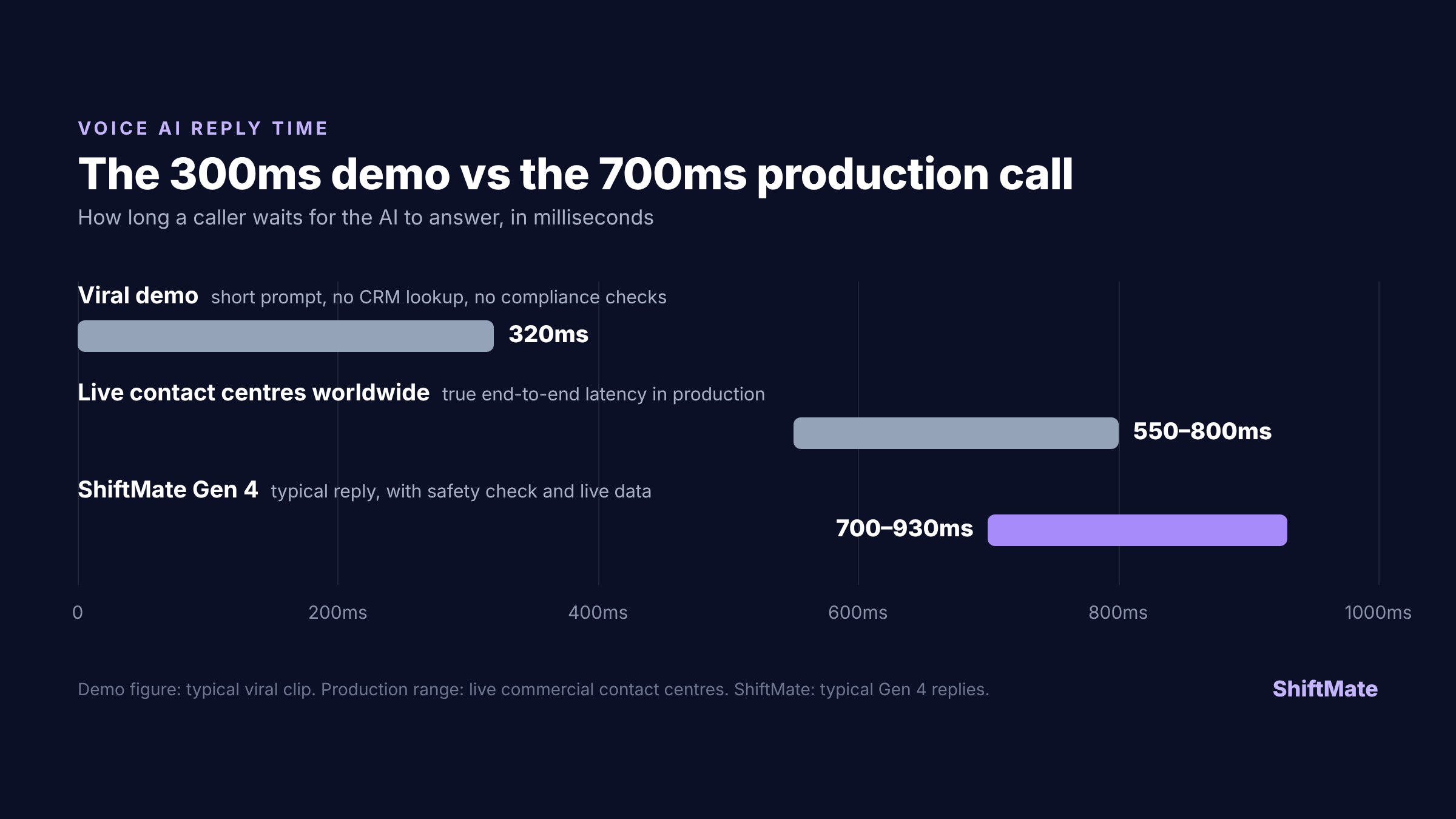
The ten best-funded voice agent startups have raised more than $5.2 billion, but the 300-millisecond replies seen in viral demos do not survive a live call. In real contact centres, end-to-end latency settles between 550ms and 800ms. ShiftMate’s Gen 4 voice AI, built in uMhlanga, typically replies in 0.7 to 0.93 seconds while checking every claim against approved facts before it is spoken, and the same engine trains human sales teams.
By Mike Steenkamp, Founder and CEO of ShiftMate · uMhlanga / Johannesburg
Across Silicon Valley and London, institutional investors have poured billions of dollars into a single, high-stakes race: building real-time voice AI capable of holding natural, compliant conversations under enterprise pressure.
The top ten enterprise voice agent startups have now collectively raised over $5.2 billion, while core infrastructure providers have commanded nine-figure funding rounds and aggressive M&A deals. Yet while global giants deploy massive war chests to solve real-time conversational AI, uMhlanga-based technology firm ShiftMate has quietly engineered a local voice orchestration layer—now in its fourth generation—that is already delivering the speed, conversational intelligence, and regulatory guardrails that international investors are paying premiums to fund—while powering both autonomous phone agents and a nationwide AI sales training platform.
How Billions Are Flowing Across the Three Layers of Voice AI
For decades, automated phone systems meant frustrating “Press 1 for sales” menus. Today, generative voice AI has turned the telephone call into one of the fastest-growing frontiers in enterprise software, with venture capital flowing across three distinct layers of the stack:
1. Speech and Audio Models (The Core Voice Layer)
Investors here back ultra-low-latency text-to-speech (TTS), speech-to-speech, and speech recognition infrastructure—led by ElevenLabs (which closed a $500 million Series D in February 2026), Cartesia, Deepgram, and AssemblyAI, with backing from Sequoia Capital, a16z, ICONIQ Growth, and NVIDIA’s NVentures. Notably, speech model providers are moving aggressively to own the runtime stack, underscored by Deepgram’s October 2026 acquisition of Daily, creator of the Pipecat voice-agent framework.
2. Developer Orchestration and Voice Infrastructure
This layer manages call routing, turn-taking, and telephony integration so developers can deploy reliable phone agents at scale. Standouts include LiveKit ($221 million raised, including a $100 million Series C), Bland AI (which closed a $50 million Series C in June 2026), Vapi (valued at $500 million), and Retell AI, which surged past $100 million in annualised run-rate revenue in November 2026 after raising just $4.6 million.
3. Enterprise Voice and Customer Service Agents (The Application Layer)
The largest cheques in 2026 have flowed to full-stack vertical and enterprise customer-experience platforms charging on outcomes rather than software seats:
Company
Focus Area
2026 Funding & Valuation Milestones
Notable Backers
Sierra Enterprise customer experience agents
$1.6B total raised (including a $950M Series E in May 2026)
Sequoia Capital, General Catalyst, Thrive Capital
Parloa Enterprise contact-centre voice agents
$560M raised; $1B+ unicorn valuation
Altimeter, EQT Ventures, General Catalyst
Decagon Omnichannel and voice support agents
$481M raised; $1B+ unicorn valuation
a16z, Accel, Bain Capital Ventures
Hippocratic AI Safety-focused healthcare voice agents
$1B+ unicorn valuation
General Catalyst, a16z, NVIDIA
Beyond the “300ms Demo” Illusion
Despite the billions pouring into the sector, a quiet divide separates viral social media demos from live enterprise deployments.
Viral clips often showcase an AI answering a trivial question in 320 milliseconds—a benchmark almost always achieved on bare-bones setups with short prompts, zero database lookups, and no compliance guardrails. The moment an enterprise connects a voice agent to a live CRM, checks a customer’s policy details, navigates cellular network jitter, and enforces regulatory rules, physics takes over.
Across live commercial contact centres globally, true end-to-end production latency settles between 550ms and 800ms—roughly seven-tenths of a second.
The industry has spent two years obsessing over 300-millisecond demos that fall apart the second you ask the AI to check a CRM or follow a compliance rule. Enterprise buyers in insurance, financial services, and outbound sales do not cancel contracts over 150 milliseconds. They cancel contracts when an AI interrupts a customer mid-sentence, hallucinates an unapproved policy term, or freezes when a real-world call gets messy.
Engineering Agents That Listen, Remember, and Answer Like Humans
Rather than chasing lab-condition vanity metrics, ShiftMate engineered its Gen 4 Voice AI around how a top salesperson actually holds a conversation: answering quickly, never talking over the caller, remembering exact details, and knowing when to say, “Let me check.”
To achieve that in live production across South African English, Afrikaans, and isiZulu, ShiftMate rebuilt four core pillars of the voice stack:
Sub-Second Streaming Speed (0.70s–0.93s): Instead of waiting for a full response to generate, ShiftMate’s pipeline warms up a single voice connection per call and starts speaking on the very first clause—after running a real-time safety check—while the rest of the answer is still being written. Typical replies land in 0.7 to 0.93 seconds depending on question complexity, while fixed lines (such as AI disclosures) and natural acknowledgements (“Sure”, “Let me check that”) fire near-instantly from a pre-rendered cache.Stereo-Tested Turn-Taking: Most AI calls fail on timing, not vocabulary. ShiftMate recorded test calls in stereo to measure every millisecond of overlapping speech and eliminated common failure modes—waiting through natural greeting pauses (such as “Hello… Priya speaking”, which can pause up to 0.84 seconds), ignoring phantom background noise, preventing “mm” and “uh-huh” backchannels from masking opt-out requests, and eliminating audio deadlocks that previously left bots silent for up to 26 seconds.Zero-Guesswork Guardrails: Standard AI agents fill knowledge gaps with confident guesses. ShiftMate’s engine verifies prices, terms, and claims sentence-by-sentence against approved facts—rewriting any unapproved claim or wrong company name in under a thousandth of a second before a word is spoken. If an answer is not in the knowledge base, the agent honestly offers a callback. In production testing, this drove wrong company names from 1 in 20 down to 0 in 135 calls, and false opt-outs down to 0 in 76 calls.Live Call Memory and a Real-Time “Coach”: Each agent extracts exact details as they are spoken (retaining “first registered October 2017”, not just “2017”) so it never asks the same question twice. Between every turn, a second AI reads the conversation in real time, tracks the stage of the call, and feeds the speaking agent a concise coaching note—quoting the caller’s exact question first so it is answered before moving forward.
Stress-Tested Against the Toughest Callers
Before facing real customers, ShiftMate’s agents are thrown into adversarial simulations against AI customers engineered to be difficult: gatekeeping receptionists, busy and sceptical decision-makers, rambling callers, serial interrupters, and prospects demanding to be removed from call lists in every conceivable phrasing.
The agent and the simulated customer never share a brief, and two independent AI judges—built on models from two separate AI companies—score every interaction. Across 1,652 checks, ShiftMate’s simulated callers achieved a 96% realism score, ensuring the voice layer is battle-hardened against real human unpredictability.
From Stress-Testing AI to Training Human Sales Teams at Scale
While building adversarial AI customers to stress-test its own voice agents, ShiftMate unlocked a far broader commercial application using the exact same underlying engine: real-time AI sales and service training for human teams.
Across virtually every industry—from financial services and insurance to telecommunications, automotive, and B2B enterprise sales—companies face the same expensive bottleneck. Onboarding new sales reps takes months, managers rarely have time to run realistic one-on-one roleplays, and most reps learn by burning real, expensive leads on live calls.
By pointing ShiftMate’s sub-second voice engine and 96%-realism buyer personas at human trainees instead of bots, businesses can put every salesperson through unlimited, hyper-realistic practice calls before they ever touch a live pipeline:
Practice Against Every Buyer Personality: Reps can dial into simulated prospects modelled on their exact industry—from price-sensitive consumers and rushed procurement managers to sceptical technical buyers—experiencing realistic interruptions, objections, and South African conversational cadence in real time.Objective, Turn-by-Turn Coaching: Using the same dual-judge evaluation architecture that scores ShiftMate’s AI agents, the training platform grades human reps immediately after every call on objection handling, product accuracy, script compliance, and discovery questioning—giving sales managers data-backed visibility across hundreds of reps simultaneously.Zero-Risk Ramp Time: Instead of losing high-intent leads while a junior rep finds their confidence, teams build muscle memory in a safe, repeatable environment—cutting onboarding time from months to days while lifting close rates across veteran reps too.
So What Does All of This Actually Mean for South African Businesses, Employment, and Training?
Whenever breakthroughs in conversational AI make headlines, the immediate question across Johannesburg, Cape Town, and Durban boardrooms—and on contact-centre floors—is straightforward: What does this do to South African jobs?
South Africa’s Global Business Services (GBS) and Business Process Outsourcing (BPO) sector employs hundreds of thousands of young South Africans, while millions more work in retail, financial, and commercial sales roles nationwide. Ignoring voice AI is not an option—global clients are already demanding AI-enabled efficiency. Yet deployed properly, deterministic voice AI does not hollow out South Africa’s workforce; it directly tackles the country’s twin challenges of productivity and youth employability:
Turning Unemployed Youth Into Job-Ready Sales Professionals Faster: One of South Africa’s biggest hiring barriers is the cost and risk of training entry-level talent with zero prior phone experience. With ShiftMate’s AI sales trainer, employers and training academies can give first-time job seekers hundreds of realistic customer conversations in their first week—bridging the skills gap rapidly and lowering the cost of hiring young South Africans.Protecting and Expanding Global BPO Contracts: International buyers choose South Africa for empathy, cultural affinity, and high-touch problem-solving. By letting reliable voice AI handle repetitive Tier-1 tasks—such as outbound lead qualification, appointment confirmations, and after-hours triage—local BPOs lower blended operating costs and win larger global contracts that create higher-value human roles.Elevating Agents From Script-Readers to Complex Closers: When AI handles routine, repetitive calls without fatigue, human agents are no longer burned out reading the same compliance disclosure 200 times a day. Calls escalate seamlessly to human specialists when nuance, emotional intelligence, or complex negotiation is required—turning entry-level seats into higher-skilled, better-compensated advisory roles.Keeping Intellectual Property and Data on Local Soil: Relying blindly on overseas voice platforms means sending sensitive South African audio across borders while paying in US dollars. Building and running POPIA-compliant voice infrastructure locally ensures South African businesses retain control over their data, enjoy predictable Rand-based economics, and build deep AI engineering skills within the domestic tech ecosystem.
The biggest risk to South African employment isn’t adopting voice AI—it’s falling behind while global competitors automate routine workflows and upskill their teams faster than we do. Whether our engine is running an autonomous voice agent or coaching a young South African salesperson through their hundredth practice objection before lunch, the goal is the same: measurable commercial performance that works in the real world.
Scaling South African Voice Infrastructure Globally
South Africa’s BPO and contact-centre industry serves some of the toughest, most regulated enterprise brands in the world. If a voice orchestration layer can handle noisy cellular lines, multi-accent speech, strict POPIA guardrails, and live database actions at seven-tenths of a second in Johannesburg or Durban, it can perform anywhere on earth.
You don’t need a $200-million Silicon Valley balance sheet to build world-class voice infrastructure. What matters in enterprise voice is deterministic reliability, regulatory compliance, and an engine that performs consistently every single time the phone rings.
See how ShiftMate’s voice agents work on the ShiftMate AI overview .
Sources
New Market Pitch, Top AI Voice Agent Startups by Fundraising (2026)
TechCrunch, ElevenLabs raises $500M from Sequoia at an $11 billion valuation, 4 February 2026
Deepgram, Deepgram is acquiring Daily, makers of Pipecat, 29 October 2026
LiveKit, LiveKit’s Series C, January 2026
TechCrunch, AI voice startup Vapi hits $500M valuation, 12 May 2026
Business Wire, Retell Surpasses $100M in Annualized Run Rate, 12 November 2026
Parloa, Parloa Valued at $3 Billion with $350M Series D
Hippocratic AI, Series C funding announcement, November 2025
ShiftMate Gen 4 voice AI test results, 2026
About the Author: Mike Steenkamp is the Founder and CEO of ShiftMate , an uMhlanga-based AI engineering firm building real-time, POPIA-compliant voice orchestration, autonomous agents, and AI sales training platforms for high-volume contact centres and enterprise sales teams. Mike on LinkedIn .
Get Featured in Our Articles Share your hiring expertise as a South African employer. We'll feature your insights with a free dofollow backlink to your website — boosting your Google ranking.
Reach thousands of job seekers Position as industry leader Share Your Expertise