AI for training and staff development
Not passive e-learning. A Gen 3 AI trainer that talks, listens, responds and coaches in real time — built from your own campaigns, QA standards and quality framework, not generic scripts.
The short answer
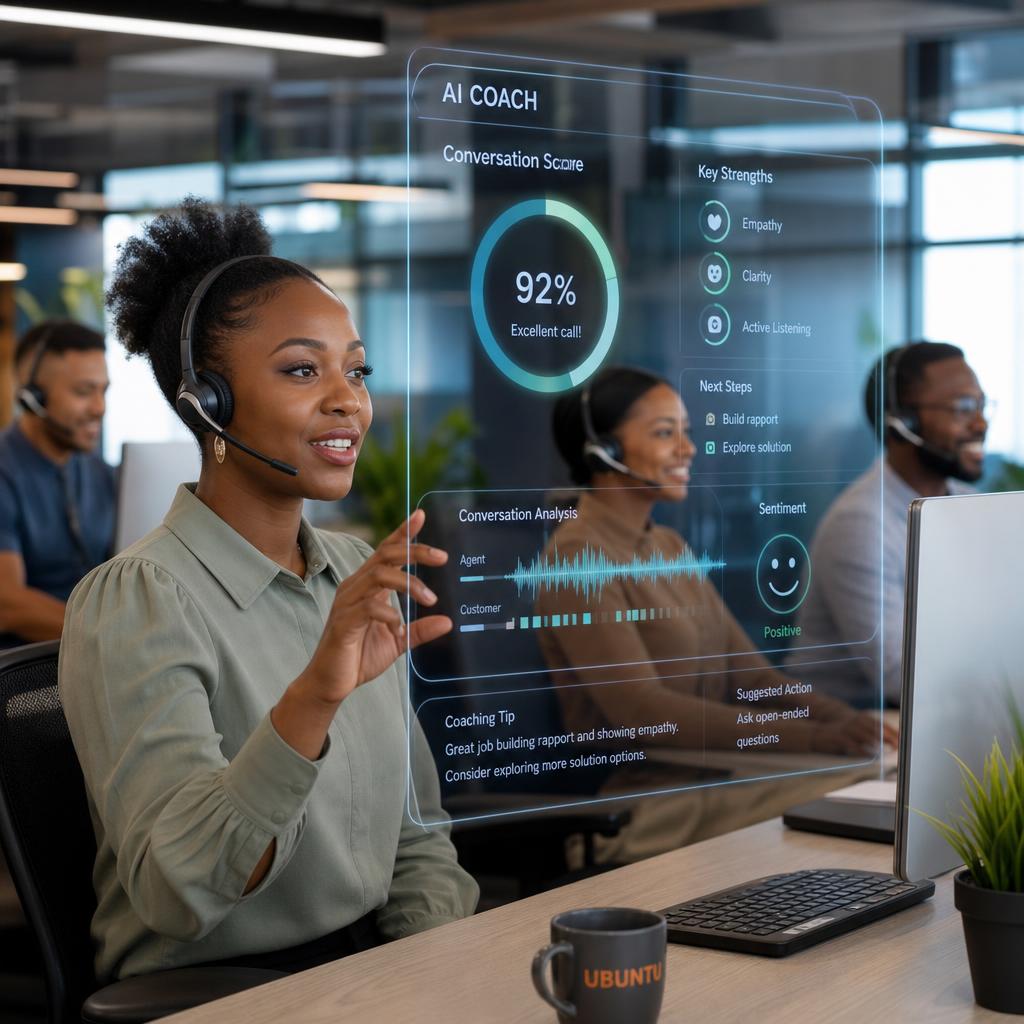
AI simulation training replaces passive e-learning with live practice: a Gen 3 AI trainer plays a customer, patient or colleague in real time, coaches the learner in the moment, and generates performance data that tells you whether training changed behaviour on the floor — not just whether someone clicked through a module.
Why most training tools fail operators
If you've run a contact centre or BPO, you already know the complaints. The pattern is consistent across the industry.
Expensive annual licences
Priced for enterprises that have no alternative, not for the volumes and margins SA BPOs actually operate on.
Generic content, not yours
Built on fictional scripts, not your campaigns, your products, your QA framework or your compliance requirements.
No evidence of improvement
Completion certificates tell you someone sat through the module. They tell you nothing about whether the person can handle a real call.
Poor support in SA
Vendors based in the US or UK, with no South African context, no local language support, and support desks that don't understand the market.
Passive by design
Video plus quiz is still passive. Learners click through to get certified, not to get ready. Muscle memory comes from practice, not observation.
No connection to performance
Training and performance management sit in different systems. Nobody can answer whether training changed what happens on the floor.
ShiftMate built its training simulator specifically to solve these failures — not as an academic exercise, but because the operators running ShiftMate's live AI programmes told us the existing tools weren't working. The simulator runs on your campaigns, your QA standards, and your quality framework from day one.
What a Gen 3 AI trainer actually does
A Gen 3 AI trainer is not a chatbot with a face. It is a fully agentic simulation: it conducts a real conversation, coaches in real time, and adapts to the learner. Here is what that means in practice.
Talks
Speaks as a customer, patient, or colleague — not a pre-recorded script but a real-time conversation generated from your campaign and QA materials.
Listens
Processes what the learner actually says, including hesitation, wrong answers and non-compliant phrasing — not just keyword matches.
Responds
Adapts the conversation based on the learner's replies, escalating difficulty when the learner handles it well, simplifying when they're struggling.
Coaches
Pauses, replays and explains in the moment. Tells the learner what they said, what they should have said, and why it matters.
Fully agentic video AI trainers
The most realistic version of AI simulation training uses a video AI trainer — an AI with a face and voice that conducts the full interaction visually, not just as audio or text. The learner sees a person, hears a voice, and responds as they would on a real call or in a real face-to-face situation.
This matters because realism is the whole point of simulation training. A learner who has practised with an AI that looks and sounds like a real customer is more ready than one who has clicked through a quiz about how to handle an angry customer. The body-memory of the conversation transfers in a way that abstract knowledge does not.
Built from your campaigns and QA standards — not generic scripts
Generic training fails for a specific reason: it is not about your product, your customers or your quality expectations. AI simulation training is only useful if the simulations reflect what staff will actually face on the floor.
Your campaigns
The AI trainer is built from your actual campaign briefs, product knowledge documents and objection-handling guides. A learner practising a debt-management campaign practises that campaign, not a fictional one.
Your QA framework
Your quality scorecard becomes the AI's evaluation standard. It coaches against the criteria your QA team actually uses, not a generic set of best practices that may not match your compliance environment.
Your real call recordings
Where permitted, actual call recordings — especially the edge cases, the difficult customers and the failure scenarios — are used to build realistic simulations that reflect the real range of interactions staff will face.
Your compliance requirements
Regulatory scripts, mandatory disclosures and POPIA-related handling — built into the simulation so compliance is practised under pressure, not studied in isolation.
Measuring readiness, not completion
A completion certificate is not evidence of readiness. It is evidence that someone sat through a module. The question training needs to answer is: can this person handle the job?
During simulation
- Call quality scores from the AI trainer
- Error patterns and what triggered them
- Improvement rate across attempts
- Confidence signal from voice and response patterns
After training, on the floor
- QA scores from real calls in the first 30 days
- Time to competency (days from training to target performance)
- Call handle time and first-call resolution
- Escalation rates vs. trained peers
Team-level view
- Which scenarios the team struggles with (so training can be re-run)
- Who is ready vs. who needs more practice before going live
- Training ROI: cost per certified agent vs. cost per ready agent
Beyond induction — continuous coaching after day one
Most training investment goes into day-one induction. Most performance problems appear on day sixty. The agents who are struggling three months in are rarely the ones who didn't understand the initial training — they are the ones who didn't get enough practice before going live, or who developed bad habits that nobody caught early.
Onboarding acceleration
AI simulation training compresses the time between day one and ready-to-go-live. Learners can do more practice iterations in less time, with immediate coaching feedback after each attempt, than any classroom or role-play session allows.
Continuous development
Training does not end at induction. AI simulation enables micro-training: fifteen-minute scenario refreshes when a campaign changes, targeted practice for agents whose QA scores show a specific weakness, and product-knowledge updates without pulling agents off the floor.
Manager and team leader training
The same simulation technology applies to managers: coaching conversations, performance reviews, disciplinary procedures, escalation handling and leadership scenarios. The people managing the floor need practice too — and most management training is even more passive than frontline training.
Measurable ongoing readiness
Instead of annual training completion records, you build a live picture of each agent's readiness across your key competency areas — updated as they complete micro-training and as their on-floor performance data feeds back into the system.
See a Gen 3 AI agent in a live conversation
The demo at demo.shiftmate.co.za/experience runs a live ShiftMate Gen 3 agent — the same underlying platform as the training simulator, interacting in real time.
Applications beyond contact centres
AI simulation training is not a contact centre product. It is a technology — and the technology applies wherever realistic conversation practice has value. Which is most industries.
Contact centres & BPOs
New-hire induction, product launches, compliance refreshes, objection handling, accent and language coaching.
Retail
Product knowledge, upsell conversations, complaints handling, returns policy, EFTPOS and loyalty programme training.
Healthcare
Patient communication, empathy training, clinical admin, appointment management and medical aid query handling.
Hospitality
Check-in scripting, complaint de-escalation, upselling F&B, handling difficult guests and accessibility queries.
Financial services
FAIS compliance, product disclosure, objection handling, KYC conversations and vulnerable-client protocols.
Franchises
Consistent brand voice across locations, product knowledge standards, customer handling and mystery-shopper preparation.
Skills & education programmes
Work readiness, job interview preparation, workplace communication and sector-specific professional skills.
Common questions about AI training
What is AI simulation training for staff?
AI simulation training replaces passive e-learning with live practice. A Gen 3 AI trainer — with a face, voice and real-time responsiveness — plays a customer, patient, or colleague while the learner handles the interaction. The AI coaches in the moment, replays what went wrong, and adapts difficulty as the learner improves.
How is AI training different from traditional e-learning?
Traditional e-learning is watching videos and clicking through slides. The learner is passive. AI simulation training is active — the learner handles conversations that feel real, makes mistakes in a safe environment, gets immediate coaching, and builds the muscle memory that classroom training cannot. Completion rates tell you nothing about readiness; simulation training produces measurable performance data.
Can AI training be built from our own QA standards and campaigns?
Yes — and this is the point. Generic off-the-shelf training does not reflect your product, your tone, your compliance requirements, or your quality framework. ShiftMate builds training simulations directly from your existing call recordings, QA scorecards, compliance scripts and campaign briefs.
Which industries can use AI simulation training?
Any industry where staff interact with customers, patients, students or the public: contact centres, retail, healthcare, hospitality, franchises, financial services, compliance-heavy environments, and formal skills and education programmes. The technology is not sector-specific — it follows wherever realistic conversation practice has value.
How do you measure whether AI training actually worked?
Completion is not a measure of readiness. AI simulation training generates performance data from the simulation itself — call scores, error patterns, confidence levels, improvement rates. ShiftMate links simulation performance to on-the-floor metrics so you can see whether training changed behaviour, not just whether staff clicked through a module.