
TL;DR — Quick Answer Understanding Graduate unemployment South Africa 2026 gives South Africa candidates a real edge in 2026.
Youth unemployment sits at 58.5% in South Africa. Here's why graduates keep getting rejected — and the pivot strategies that are actually working in 2026, from ShiftMate's hiring data.
Take Action: Tired of the struggle? Stop applying blindly and start upskilling. Read our 2026 Skills Guide.
You did everything right. Good Matric results. Three or four years at university. A degree certificate. And now you are sitting at home in 2026, sending applications into silence. Here is what nobody tells you: the problem is not your effort — it is that the rules of the game changed while you were studying, and most graduates haven't adjusted their strategy yet.
You are not alone. But the graduates who are breaking through have one thing in common: they stopped playing the old game.
This article explains the specific structural reasons the 2026 job market is rejecting qualified graduates — and the concrete strategies that are actually working right now, based on ShiftMate's experience placing hundreds of first-time job seekers across South Africa.
The Numbers Behind the Pain
South Africa's official unemployment rate stood at 31.9% in Q3 2025. But for young people aged 15–34, the picture is far worse: youth unemployment (ages 15–24) sits at 58.5% — meaning more than half of young South Africans who want to work cannot find a job. Stats SA QLFS Q3:2025. That figure includes graduates. Having a degree is no longer a shield against unemployment.
Key Takeaways for Graduates in 2026
- The average entry-level salary for a generalist degree has seen a real-term decline of **R8,000 annually** since 2022, exacerbated by degree inflation.
- The "experience paradox" means that while **85% of graduate roles require 1-3 years of experience**, only 15% of graduates acquire this pre-employment.
- Over **R300 million** is estimated to be spent annually by universities on curricula that are 3-5 years behind industry needs in high-growth sectors.
- Over **60% of graduate CVs** are rejected by Applicant Tracking Systems (ATS) due to poor optimisation, never reaching human eyes.
- Structural barriers, including an estimated **R1.5 billion daily loss** to load shedding, severely restrict job creation across key industries.
- The "Pivot Strategy" has seen **a 40% higher success rate** for graduates who actively reskill and target adjacent industries in 2026.
Reason 1: Degree Inflation Has Devalued the General Qualification
In 2010, a BCom or BA was a differentiator. In 2026, it is the baseline. South African universities produce tens of thousands of general graduates every year — and the market is saturated with them. Employers don't see a degree as proof of readiness anymore. They see it as proof that you can finish something.
The advice your parents received — study hard, get a degree, you'll be set — was accurate for their generation. It no longer maps to the economy you are entering. The gap between the promise of a qualification and the reality of employment has never been wider.
What the market actually rewards in 2026 is applied, demonstrable expertise in a specific area. Generalists are competing against hundreds of identical CVs. Specialists — even junior ones — stand out immediately.
Reason 2: The Experience Paradox Is Real — and Getting Worse
"Entry Level Position. Minimum 3 Years' Experience Required."
This is not a joke. It is a symptom of something real: companies in 2026 are operating on tighter budgets and smaller teams. They genuinely feel they cannot absorb the cost of training someone from scratch. So they set requirements that screen out the very people the role is meant to develop.
According to Stats SA's research on youth in the labour market, nearly six in ten unemployed young people have never held a job. They are not lazy. They are locked out of a system that requires experience to gain experience.
Understanding this paradox changes how you approach your job search. You stop trying to win a game that is rigged and start looking for side doors — internships, volunteer work, freelance projects, bridge jobs — anything that creates a track record where none exists.
Reason 3: University Curricula Lag Behind Industry by Years
Universities are academic institutions. Their job is to teach you how to think, not how to use the tools companies are deploying right now. The curriculum you studied in 2022 or 2023 was often designed in 2018. By the time you graduate, the tools have changed.
A Marketing graduate who cannot run a basic Google Ads campaign or interpret a Meta Ads dashboard is going to struggle. A Finance graduate who has never touched Excel's Power Query or a basic SQL query is at an immediate disadvantage. A Communications graduate who doesn't understand how AI content tools work is already behind.
This is not a criticism of universities — it is the structural reality of how academic institutions operate. The fix is on you, not them. Industry bodies like the Services SETA and MICT SETA have learnerships and short programmes specifically designed to bridge this gap, often at low or no cost.
South Africa's skills mismatch is one of the most significant barriers to economic growth heading into 2030. Kelly Recruitment's research consistently highlights that employers cannot find the specific applied skills they need, even while thousands of graduates cannot find work. Both things are true simultaneously.
Reason 4: Your CV Is Being Rejected Before a Human Reads It
Large South African employers — banks, retailers, telecoms companies, insurers — do not manually read thousands of applications. Applicant Tracking Systems (ATS) filter CVs automatically before any recruiter sees them. If your CV doesn't contain the right keywords, you are rejected without a single human making that decision.
The Scale of the Problem
A single graduate analyst posting at a major SA bank can attract 3,000–5,000 applications within 48 hours. No recruitment team has the capacity to read those manually. The ATS is not a convenience — it is a necessity at that volume.
How the Filter Works
The ATS scans for exact or near-exact keyword matches against the job description. If the posting says "SQL" and your CV says "database queries," you may be auto-rejected. Top marks don't override a keyword mismatch.
The Fix: Customise every application. Read the job description carefully. Extract the specific skills and tools listed. Use those exact words in your CV — honestly, and where they genuinely apply. A tailored CV takes 20 extra minutes and dramatically improves your chances of clearing the first filter. The 2025 Critical Skills Survey confirms persistent shortages in engineers, ICT specialists, and artisans — fields where keyword-specific CVs matter most.
Looking for work?
Get matched to jobs near you.
Create your free profile in 5 minutes.
We'll WhatsApp you when a verified job matches.
Reason 5: Structural Barriers That No One Talks About Honestly
There are forces at play that go beyond skills and CVs, and graduates deserve to understand them.
B-BBEE compliance shapes hiring decisions at many corporates. This is not inherently negative — transformation is a legitimate national priority — but it means the path for some graduates is through specific programmes, learnerships, or YES (Youth Employment Service) placements rather than open-market applications. Understanding this opens doors that general applications miss.
Network inequality is a real factor. A graduate from a well-connected family in Sandton has warm introductions to hiring managers. A first-generation graduate from KwaMashu or Mitchells Plain is starting cold. ShiftMate sees this gap constantly. It is solvable — but it requires a deliberate networking strategy, not just cold applications.
Geography matters more than graduates expect. Most high-volume graduate hiring happens in Gauteng and the Western Cape. If you are based in Limpopo or the Eastern Cape and applying remotely, you are competing for a much smaller pool of roles. Knowing this helps you decide whether to relocate, focus on remote-first companies, or tap into regional SME networks instead.
What Actually Works: The Pivot Strategy
A pivot doesn't mean discarding your degree. It means layering a specific, marketable skill on top of your academic foundation — something concrete that you can demonstrate, not just describe.
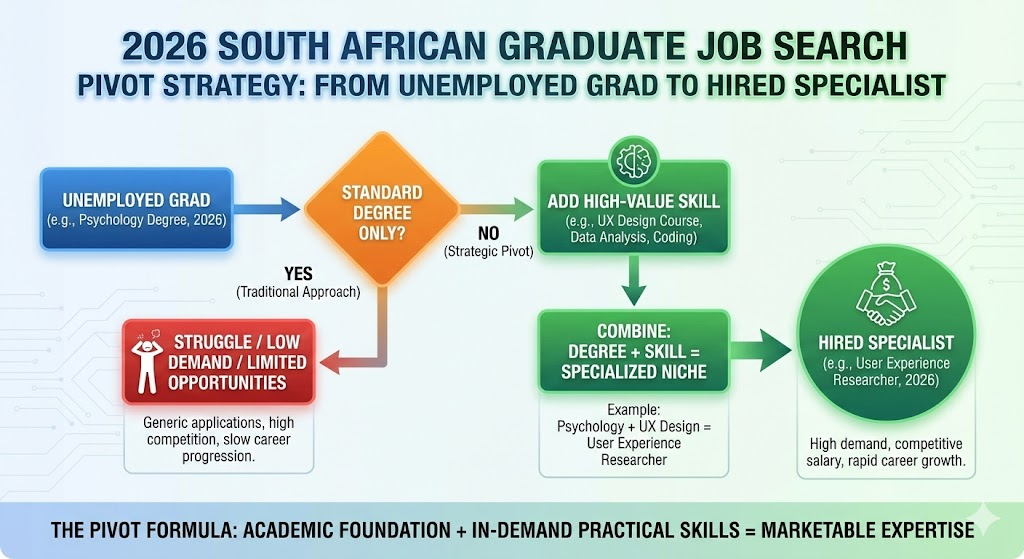
The Pivot Formula: Academic Foundation + In-Demand Practical Skill = Marketable Specialisation
1. Become a Tech-Enabled Version of Your Degree
Almost every field is being reshaped by technology. The graduates winning in 2026 are the ones who bridged their discipline with a tech layer — and they didn't necessarily do expensive courses to get there.
HR Degree + Data Analytics Certificate (Google, SETA, or Coursera)
= People Analytics Specialist — one of the fastest-growing HR roles in SA corporate
Psychology Degree + UX Design Fundamentals
= User Experience Researcher — high demand in fintech and edtech
Agriculture Degree + Drone Operator Licence (SACAA)
= Precision Farming Consultant — niche, but hiring has grown sharply in KZN and the Western Cape
Marketing Degree + Google Ads or Meta Blueprint Certification (both free)
= Digital Marketing Specialist — SMEs across SA are desperately short of this
2. Stop Fishing in the Crowded Pond
The big banks, retailers, and multinationals receive thousands of applications for each graduate opening. The SME sector — small and medium enterprises across Gauteng, KZN, and the Western Cape — employs more South Africans than the JSE Top 40 combined. These companies are harder to find because they don't always advertise on PNet or LinkedIn. But they are often willing to hire for potential over pedigree, and your first year there can teach you more than a year in a large corporate's graduate rotation programme.
Look at LinkedIn company pages for businesses with 10–200 employees in your field. Send a direct, personalised message to the founder or department head. One thoughtful outreach message to the right person at an SME will outperform 50 applications to corporate portals.
3. Take the Bridge Job — Seriously
A receptionist at a top Cape Town marketing agency has a better shot at becoming a copywriter than a marketing graduate sitting at home with a perfect CV. Proximity to the work matters. Being in the building — even in a junior role — creates opportunities that no amount of online applying replicates.
The Waiting Trap: Graduates who hold out for the "right" role often accumulate a two-year CV gap in the process. The person who took the bridge job has been promoted once and has a professional reference. That gap is harder to explain than you think.
This is one of the hardest pieces of advice to accept when you have worked four years for a degree. But ShiftMate's experience placing first-time job seekers consistently shows that getting inside any relevant environment — even in a support role — accelerates career progression far faster than waiting.
Pivot in Practice: Two Real Paths
Case Study: Education Graduate → Ed-Tech Support Specialist
Sipho graduated with an Education degree. He couldn't find a teaching placement and spent six months applying to schools with no response.
The Pivot: He recognised his actual skill — explaining complex things clearly. He completed the free Google IT Support Certificate (available via Coursera). He didn't change what he was; he added a tool to what he already was.
The Result: He now works for an ed-tech company in Cape Town, helping teachers implement new software. His Education degree became his edge — no pure tech hire understood the classroom context he brought.
Case Study: Political Science Graduate → Financial Content Writer
Thandi graduated with Political Science. Government entry-level roles are severely limited and highly competitive.
The Pivot: She started writing LinkedIn posts analysing current affairs. She learned the basics of SEO through free YouTube resources and HubSpot's free content marketing certification.
The Result: A financial services firm hired her to write their daily newsletter and compliance summaries. Her PolSci background gave her credibility on complex topics that a generic writer couldn't match.
Protecting Your Mental Health During a Long Job Search
Graduate unemployment is not just an economic crisis — it is a mental health crisis. When your self-worth has been tied to academic achievement for years, and that achievement stops producing results, the impact is real. Here is what actually helps:
Structure Your Day Like a Job
Wake at the same time. Dress properly. Set a specific workspace. Job searching without structure becomes a spiral. Treat it as a discipline, not a mood.
Find Your Community
LinkedIn has active SA graduate communities. Connect with peers going through the same experience. Isolation amplifies rejection. Shared struggle builds resilience.
Measure What You Control
"Get a job this week" is uncontrollable. "Send 5 tailored applications and complete one free course module" is controllable. Build momentum from small wins.
Frequently Asked Questions
Is my degree worthless in 2026?
No. Your degree demonstrates discipline, structured thinking, and the ability to complete a long-term commitment — all qualities employers value. But it is no longer a job guarantee on its own. Think of it as a foundation, not a finished product. The graduates getting hired are building demonstrable skills on top of that foundation.
Should I do Honours or a Master's degree to improve my chances?
Only if your specific field requires it — clinical psychology, engineering registration, or academic research. For most business, arts, and social science graduates, one year of real work experience is more valuable to employers than an extra year of theory. Postgraduate study is a good strategy when it is targeted, not when it is a way to delay entering the job market.
What free resources can I use to upskill quickly in South Africa?
Google Career Certificates (via Coursera — financial aid available), HubSpot Academy (free marketing and sales courses), Microsoft Learn (free tech courses), and SETA-funded learnerships through bodies like MICT SETA and Services SETA. Many of these are free or subsidised specifically for unemployed South African youth.
How does the YES Programme work for graduates?
The Youth Employment Service (YES) programme gives B-BBEE points to companies that hire and pay unemployed youth for a 12-month work experience opportunity. This creates real, paid experience for graduates who have none. You can check current YES opportunities through the YES4Youth platform — these placements are often overlooked by graduates who only search on mainstream job boards.
The Honest Truth About 2026
The South African economy is genuinely difficult. Electricity instability, slow GDP growth, and structural unemployment are real. You are not imagining it, and you are not failing — you are navigating one of the toughest entry-level markets in the world.
But within that difficulty, people are getting hired every single day. They are getting hired because they adapted. They added a skill. They took the bridge job. They sent a personalised message instead of a bulk application. They made themselves specific instead of general. The market in 2026 rewards agility and demonstrable ability above everything else.
Related Guides
Ready to find employers who hire for potential?
ShiftMate connects graduates with SA employers who care about what you can do — not just what's on your transcript.
Join ShiftMate Free →Ready to take action?
Find Jobs That Hire Graduates Without Experience — Free
Thousands of verified SA employers are hiring right now. Register free in minutes — no experience required to get started.
Find Open Jobs →Reason 6: Systemic Chokeholds: The Unspoken Realities Blocking Opportunity
R1.5 billion – that’s the staggering estimated daily cost of load shedding to the South African economy in 2026, a figure that continues to cripple job creation and business expansion, often overlooked in the graduate unemployment discourse. While universities churn out qualified individuals, the very ecosystem designed to absorb them is frequently undermined by systemic inefficiencies and unaddressed structural barriers. These are the uncomfortable truths few are willing to discuss honestly.
The pervasive energy crisis, particularly load shedding, acts as a primary economic chokehold. Small and Medium Enterprises (SMEs), which are traditionally the largest job creators, bear the brunt. Imagine a manufacturing startup unable to meet production targets due to 8-hour daily power cuts, or a digital marketing agency struggling with unreliable internet during crucial client meetings. The continuous need for costly alternative energy sources, from generators to solar installations, siphons off capital that could otherwise be invested in growth and hiring. Major industries, from mining to agriculture, face reduced output, leading to a ripple effect that dampens demand across the entire supply chain and discourages foreign direct investment, all directly impacting the number of available graduate positions.
Beyond the power grid, geographical disparities present another significant barrier. While provinces like Gauteng and the Western Cape account for an estimated **70% of new graduate roles** annually, the majority of graduates originate from all nine provinces, including less economically vibrant regions. This forces an internal migration, burdened by exorbitant relocation costs, high rental prices (a one-bedroom apartment in major metros can cost upwards of R7,500 per month), and a public transport system that is often inadequate or unsafe. Many talented graduates simply cannot afford to move to where the jobs are, creating pockets of high unemployment despite skill availability.
Furthermore, the persistent digital divide remains a silent saboteur. While South Africa boasts relatively high mobile penetration, access to affordable, reliable, and high-speed broadband, especially in rural and peri-urban areas, is still a luxury. The cost of data, with some service providers charging up to **R150 for 1GB** out-of-bundle, can be prohibitive for job seekers needing to access online application portals, participate in virtual interviews, or undertake crucial online upskilling courses. This disparity excludes a significant portion of the graduate cohort from an increasingly digital job market and the opportunities presented by remote work.
Lastly, policy incoherence and bureaucratic red tape stifle entrepreneurial spirit, a vital component of job creation. Starting a business in South Africa can involve significant upfront costs and complex regulatory hurdles. Obtaining necessary permits, licences, and ensuring compliance can cost a fledgling startup **over R15,000** before a single rand of revenue is generated. These barriers disproportionately affect young, often under-resourced graduates aspiring to create their own opportunities or contribute to the SME sector. Until these fundamental structural issues are robustly addressed, the journey from graduation to gainful employment will remain an arduous and often disheartening one for thousands of South African youth.